
Enter a few search terms, click “Search,” and a list of results appears just a few seconds later. Finding academic literature can seem surprisingly easy. But what’s actually behind a list of results like that?
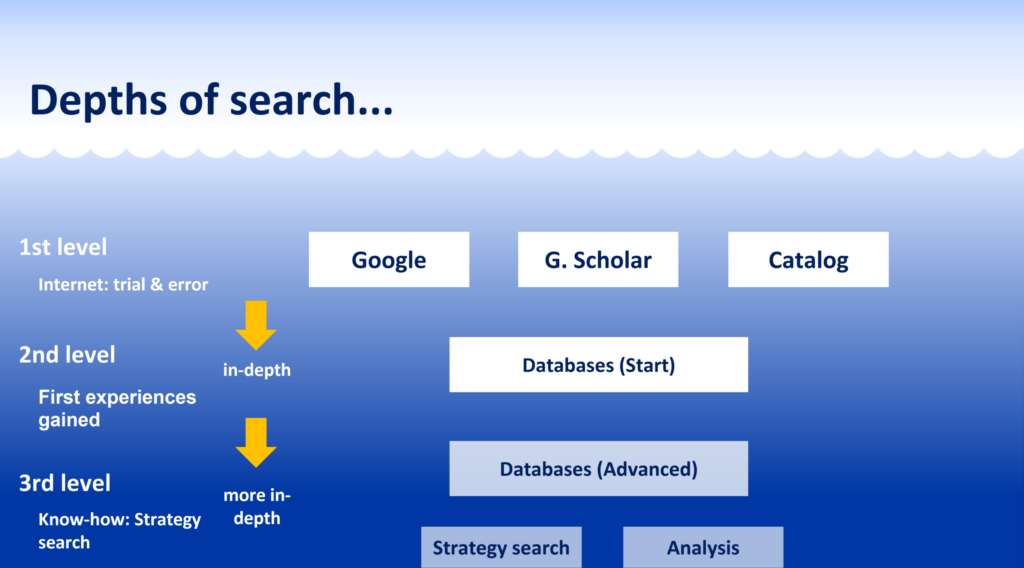
Anyone conducting academic research must first invest a fair amount of time and effort. A research question must be translated into appropriate search terms, a suitable database must be selected, and a search strategy must be developed. Search results must be reviewed and evaluated, search queries adjusted, and new leads pursued (see, among others, Finding a Needle in a Haystack – Discovering Specialist Information).
However, research involves more than just searching for relevant terms. For example, starting with a publication you are already familiar with, its references can lead you to older publications, while citing publications can point the way to more recent research. Such possibilities have already been illustrated using the example of several specialized tools in Web of Science.
The cost of research, therefore, goes beyond monetary expenses. It also consists of the time, attention, and effort required to turn a question into a meaningful search and a list of results into relevant knowledge.
But before even a single result can appear on our screens, a lot had to happen first.
How much does a list of results cost?
In order for scholarly publications to be found, information about them must be collected, structured, and linked together. Titles, authors, publication years, abstracts, keywords, references, and other metadata enable us to search for literature and identify connections between publications.
This metadata does not create or maintain itself. This requires generating, importing, verifying, supplementing, standardizing, and linking data. Staff must identify authors and institutions as unambiguously as possible, connect publications through identifiers, and record citation relationships. This requires technical systems and standards, as well as organizations and people who develop and operate these infrastructures and improve the quality of the data.
So even the structure behind a list of search results consumes resources.
In his article “Open Knowledge = Open Metadata and Open Full Text,” published during Open Access Week 2021, Aaron Tay discussed the importance of metadata for open knowledge. According to the article, open full texts alone do not solve all problems. Structured and reusable metadata make it possible to find and link scientific content and to build new services and tools based on it.
Research infrastructure also costs money, quite literally
In addition to this often invisible work, there is a very visible form of cost: licensing fees.
At the Technical University of Hamburg (TUHH), the university library provides, among other resources, the two multidisciplinary citation databases Scopus and Web of Science. These are accessible to TUHH members via the university network. However, just because no invoice appears when you start a search does not mean that using them is free.
The significance of these costs became clear as early as 2023, when TUHH surveyed its members about whether to continue licensing Scopus and Web of Science. At that time, the two databases together cost the TUB a mid-five-figure sum per year. Regular price increases raised the question of whether sufficient funding would remain available for both services in the future or whether other literature resources should take priority. This is not a one-time decision. Limited acquisition budgets, changing prices, and new offerings require regular reassessment. These decisions also demand resources: staff must monitor offerings and price trends, evaluate usage and demand, and prepare recommendations for future funding.
At the same time, the feedback revealed why this decision is not so straightforward. Scopus and Web of Science cover similar content but do not necessarily yield the same results. For example, some participants reported that, during a search, they had found certain publications in only one of the two databases.
The research infrastructure available can therefore help determine what knowledge we are able to find in the first place. And, consequently, what knowledge is recognized, taken up, and used for further research.
What if the research infrastructure is open?
In addition to commercial offerings, there are also open research infrastructures. One example is OpenAlex, which we introduced earlier this year as an open alternative for academic research. Anyone can access the bibliographic database and use it for scholarly research without an institutional license. However, in the context of “The Cost of Knowledge,” the key point goes beyond the fact that researchers do not need a license from their university to use it. After all, OpenAlex also comes at a cost.
Providing this service requires gathering, processing, and linking data from various sources, maintaining the technical infrastructure, and continuously developing the database. Even in this context, “freely accessible” does not mean “free of costs.”
The difference lies elsewhere: OpenAlex is based on openness and transparency. The data comes from various sources, such as Crossref, ORCID, DOAJ, DataCite, and scholarly repositories. The methodology is also transparently documented. Furthermore, users can reuse the data for their own analyses and applications via APIs and data snapshots. However, keeping the open services and infrastructures that support these offerings running requires ongoing maintenance and long-term funding. The TUHH therefore supports science-driven infrastructure services that, for example, maintain databases, provide persistent identifiers, or develop open-source software. So even here, openness does not mean that there are no costs involved. Rather, the question is how such infrastructures can be sustained and managed collaboratively.
So the question is not just how much a research infrastructure costs. It is also crucial to consider who can use it and under what conditions users can reuse its data for further research, analysis, or new applications.
Not all search results are the same
An open database like OpenAlex does not automatically render commercial services obsolete. The specific research question and how researchers intend to use the results determine which research source is most appropriate. Databases differ in terms of their data collections, coverage, selection criteria, and features. That is precisely why it can be useful to draw on a variety of resources for a research project. In his comparison of various academic search tools, Aaron Tay also demonstrates how their coverage and search capabilities can vary and why different tools are suitable depending on the research question.
If you’d like to try OpenAlex for yourself and take a closer look at its search options, filters, and data access, you’ll find a detailed introduction in the tub.torial “What is OpenAlex and how can you use it for research?”
After all, a list of results is never simply a neutral window onto “the entire field of science.” It also depends on what data a system contains, how complete, well-described, and interconnected that data is, and which search options the system offers.
That’s why good research involves more than just asking: What am I looking for? But also: Where should I look, and what can I actually find there?
Just because it’s been found doesn’t mean it’s accessible
And even if a relevant publication appears in the search results, another question remains: Can I actually read it? Discoverability and accessibility are not the same thing. A database can show me that a publication exists without me subsequently having free access to the full text. In that case, access depends, for example, on whether the publication is available via Open Access, whether the library or institution has licensed the relevant content, or whether other means of obtaining the literature are available.
This, too, is part of the cost of seeking knowledge. A publication may be found, yet it may still require additional time, effort, or funded infrastructure before its content can actually be used. For open science, therefore, we need both: knowledge that is accessible and the means to find that knowledge in the first place.
How much does it cost to find knowledge?
So when we discuss the cost of knowledge during Open Access Week under the theme “The Cost of Knowledge,” it’s also worth taking a look at the search for knowledge.
Between a research question and a useful source lie search terms, databases, metadata, technical infrastructure, and, last but not least, time and attention. Some of these costs are borne by the people conducting the research. Others are borne by libraries and universities when they fund and provide research infrastructure. And still others invest time and resources in developing metadata, standards, and links that make many of these research options possible in the first place.
Open initiatives like OpenAlex do not eliminate these costs. However, they do change the conditions under which such infrastructure can be used and its data can be reused. Perhaps that is why open knowledge involves more than just free access to a publication. Knowledge must also be discoverable. And discoverability, too, comes at a price.
So the question is not just: What does it cost to make knowledge accessible? But also: What do we invest in to make knowledge discoverable?
Our contributions to Open Access Week 2026
