
Where does the TUHH academic staff plan to publish in 2026? We asked, and you answered.
- These are the favorites
- Who took part in the survey?
- Why do we ask?
- About the details
- Praise, criticism, suggestions, and requests
- Consultation and support for your publication planning
1. These are the favorites
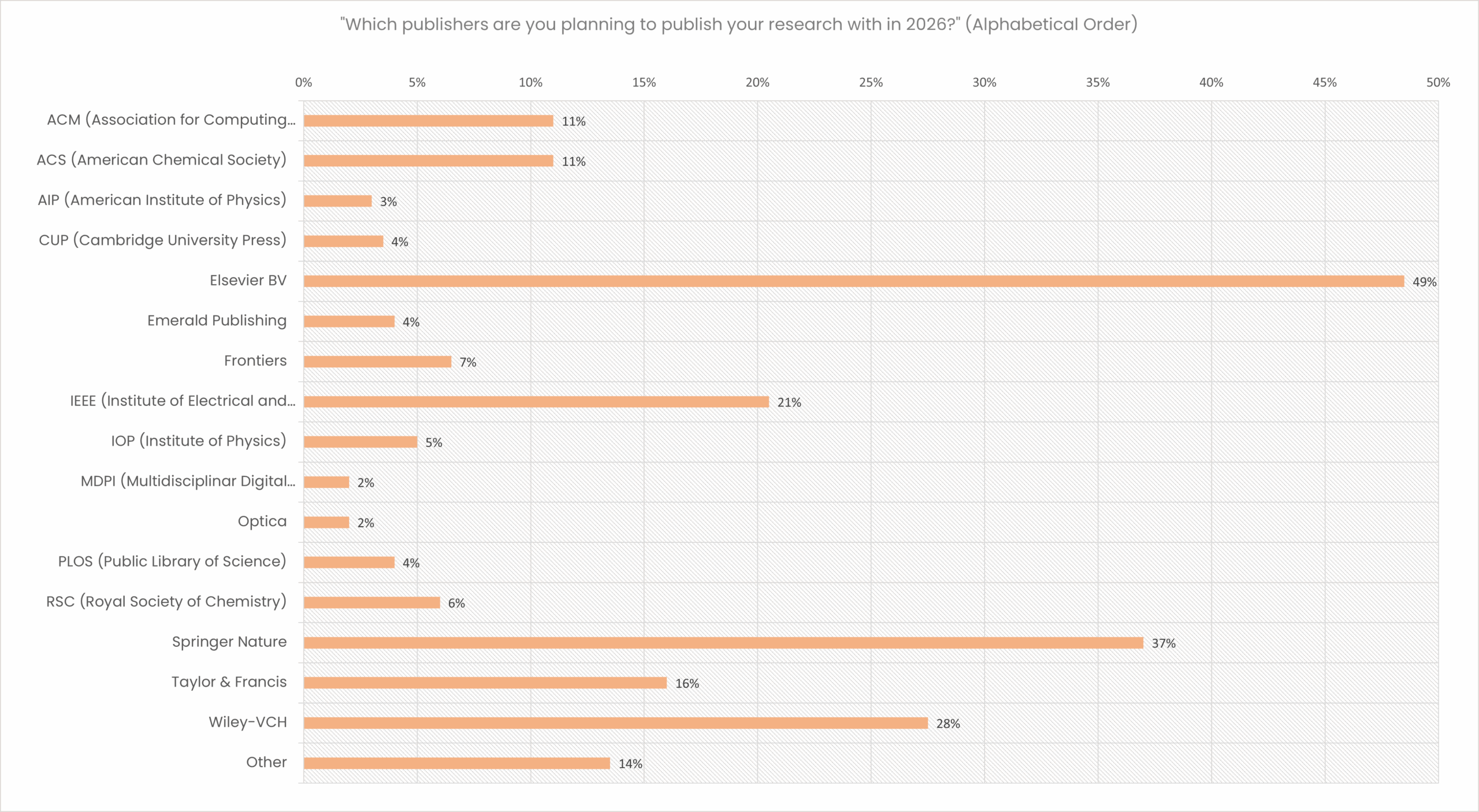
In our survey of academic staff at the TUHH, we asked which academic publishers or publication service providers are preferred when choosing a venue for publication.1 Based on the number of planned publications, a clear ranking of the top five TUHH publishers among the survey participants emerges:
- Elsevier BV – reported by 49 % of respondents
- Springer Nature – 37 %
- Wiley-VCH – 28 %
- IEEE (Institute of Electrical and Electronics Engineers) – 21 %
- Taylor & Francis – 16 %
Other significant organizations included ACM (Association for Computing Machinery, 11%) and ACS (American Chemical Society, 11%), Frontiers (7%), RSC (Royal Society of Chemistry, 6%), and IOP (Institute of Physics, 5%). PLOS, Cambridge University Press, and Emerald Publishing (each 4%), AIP (3%), MDPI, and Optica (each 2%) were also mentioned, though to a slightly lesser extent. A few other publishers were cited under the “Other” option, including ASME, APS, Canadian Géotechnique, SAGE Publications, and Dagstuhl Publishing.
2. Who took part in the survey?
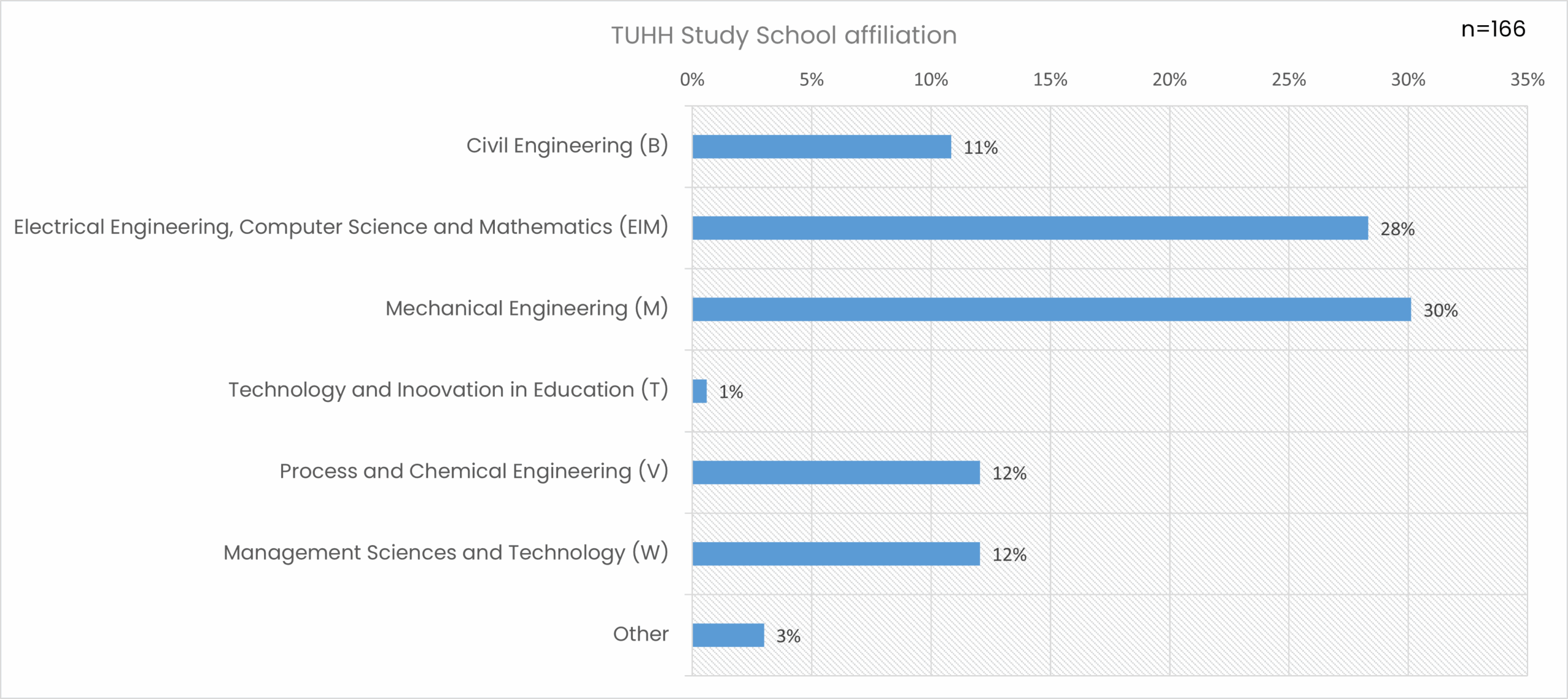
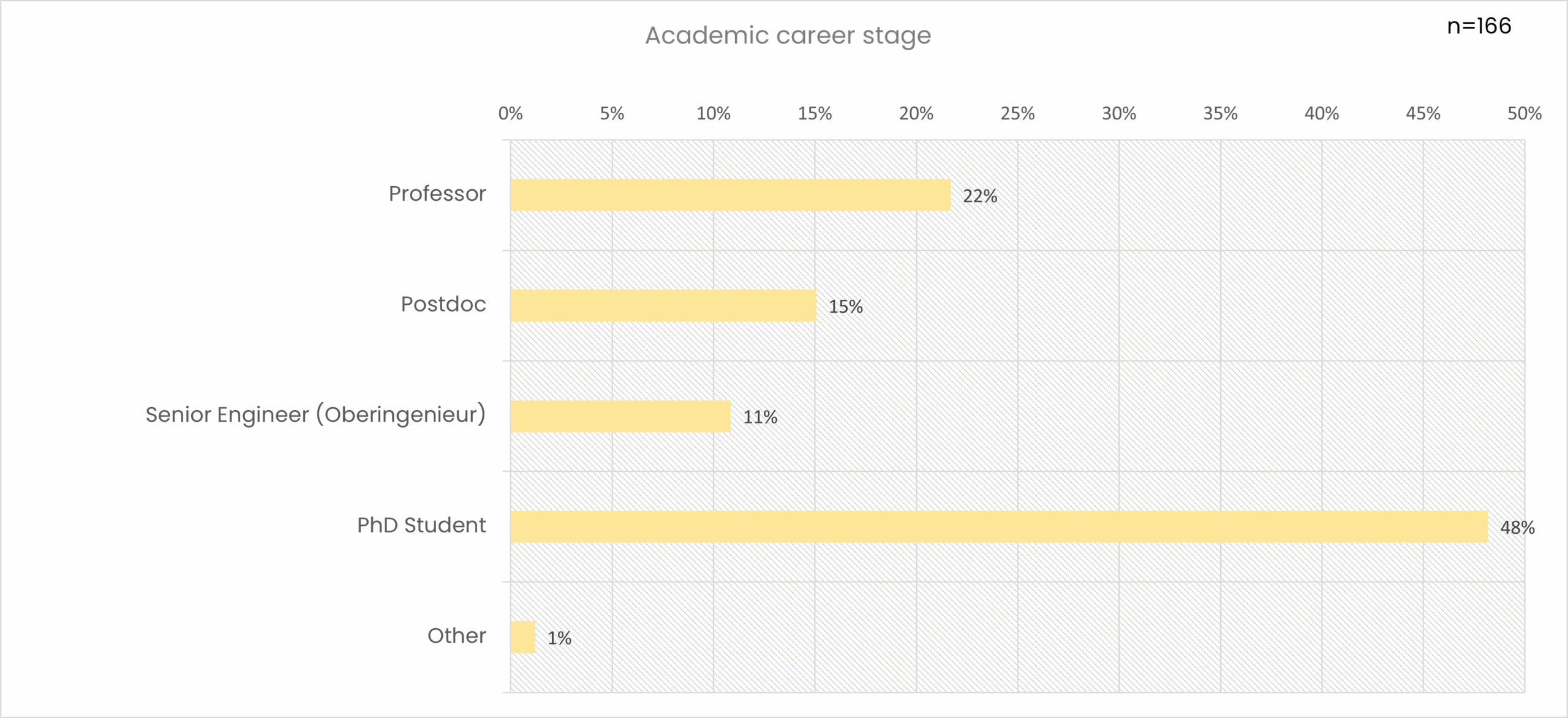
From December 17, 2025, to January 16, 2026, we asked for the TUHH researcher’s input in our anonymous online survey. Of the 166 academic staff members who participated, 134 completed the questionnaire in full.
Among the survey participants are
- 36 professors,
- 18 senior engineers,
- 25 Postdocs and
- 80 PhD students.
We received the most responses from the TUHH Study Schools EIM (Electrical Engineering, Computer Science, Mathematics) and M (Mechanical Engineering) with 47 and 50 completed questionnaires. Twenty people each from the Study Schools W (Management Sciences and Technology) and V (Process and Chemical Engineering) completed the survey, 18 from the deans’ office of B (Civil Engineering), and one person from T (Technology and Innovation in Education).2
3. Why do we ask?
When making acquisition decisions, we apply various criteria, some of which are based on key indicators. Our decision-making process is guided, for example, by cost-benefit analyses aimed at ensuring the efficient use of our budget, thorough reviews of the specified terms of use, and our acquisition profile — all to ensure that our media purchases and licensing agreements reflect our research priorities as comprehensively as possible.
Another key criterion for ensuring that the University Library provides information tailored to your needs is aligning our publishing licenses with the priorities of researchers at TUHH. That is why, at the turn of the year 2025/2026, we surveyed them online to find out which publishers they plan to use this year for one or more publications of their research findings.
The results help us to
- develop a publication forecast for the TUHH,
- optimize our acquisition strategy with regard to open-access publication funding and
- to improve the TUB’s overall service portfolio.
4. About the details
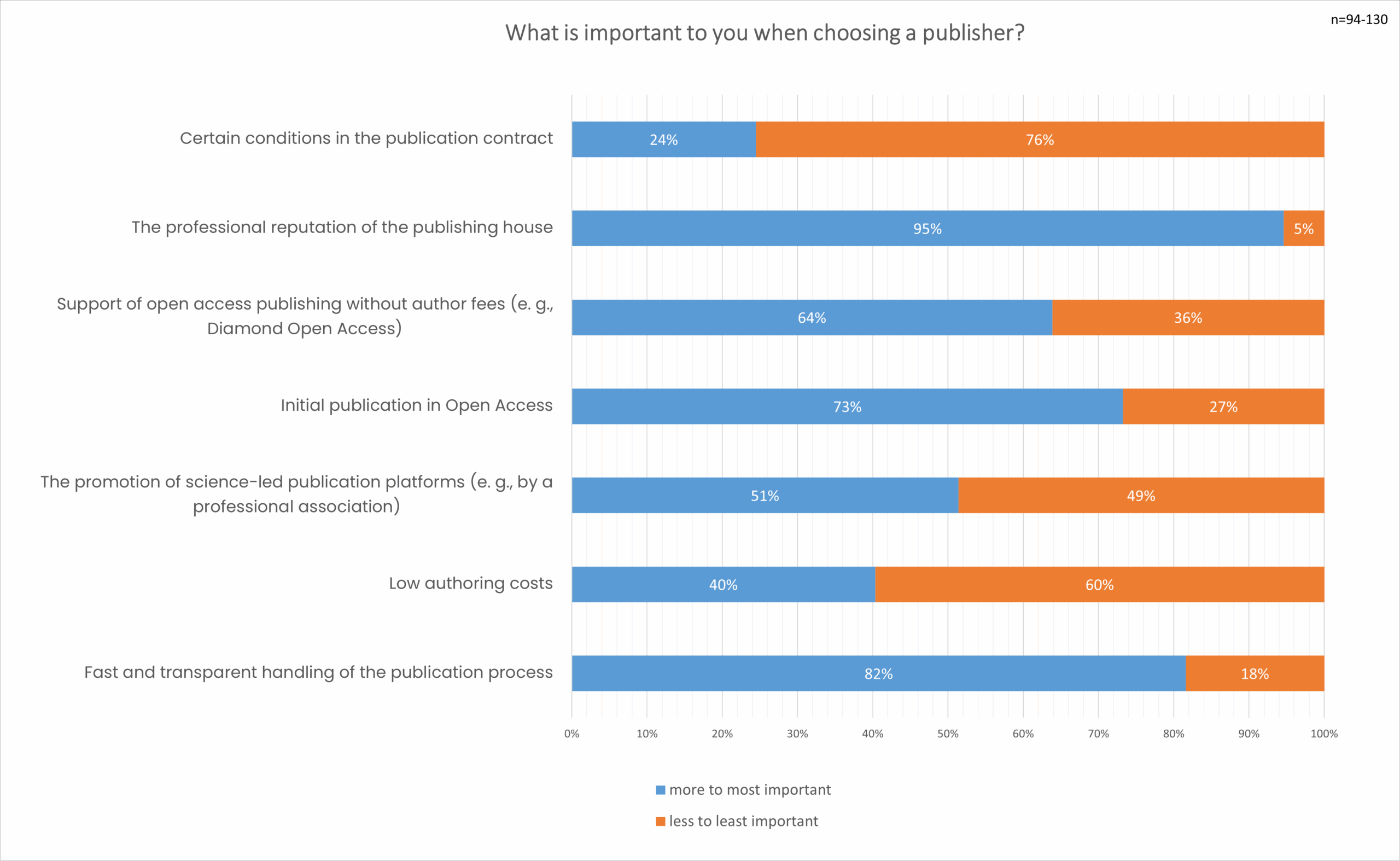
Unsurprisingly, the key criteria for choosing a publisher were professional reputation (95% of respondents cited this as important or very important) and a fast and transparent publication process (82%).3 The majority of respondents (73%) also consider it important that the planned articles be published first in open access. Additional findings:
- While 64% of respondents support open-access publication channels without author fees as a decision-making criterion, reducing publication costs is a relatively rare factor (40%).
- About half (51%) want their publication to support relevant professional associations.
- Only a minority of 24% of respondents base their publication plans (in part) on the terms of the author contracts.
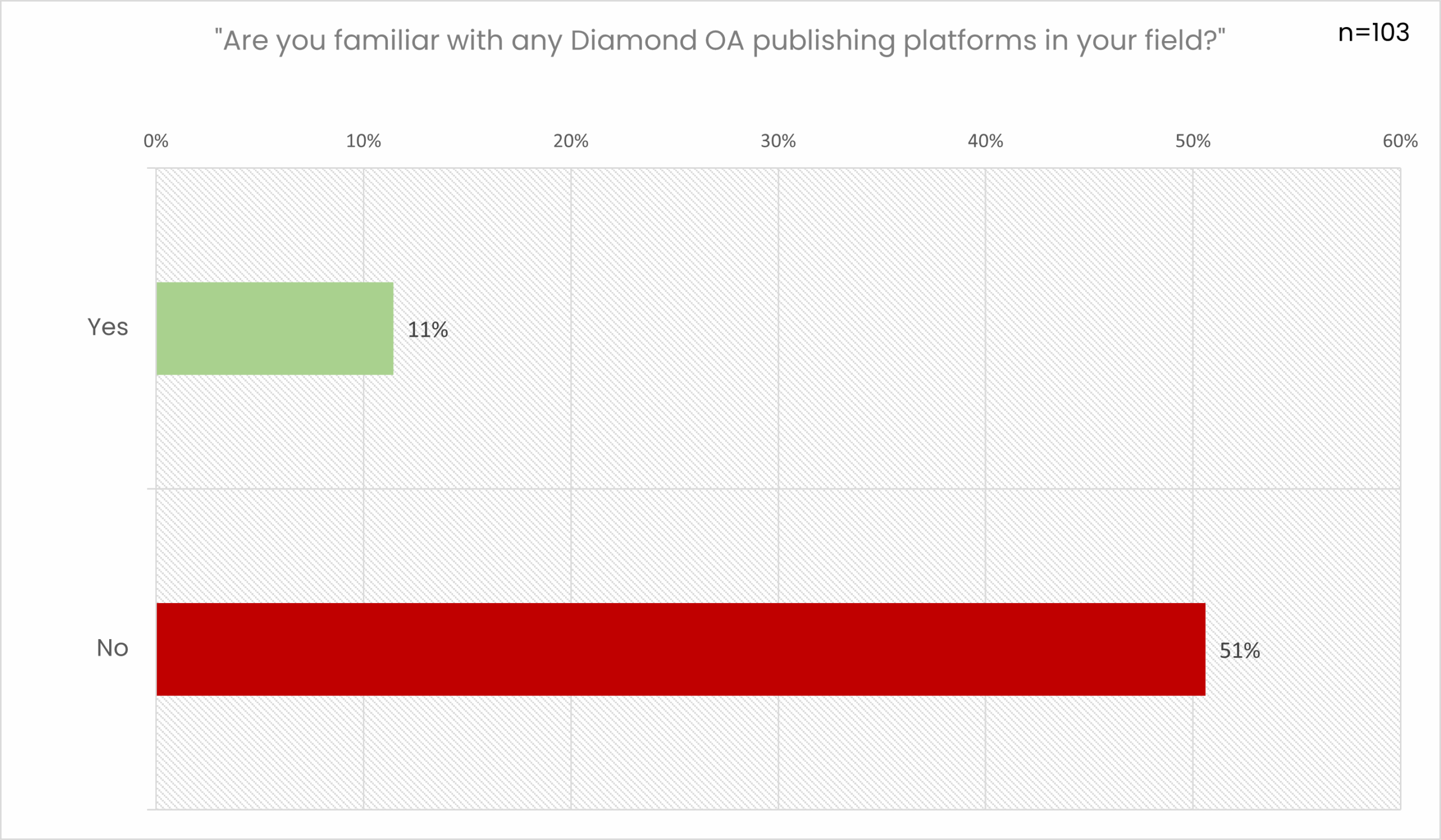
A key focus of research policy—both in Germany and internationally—regarding the future of publishing is currently on the “Diamond Open Access” model. This refers to publications whose costs are not borne by the authors themselves (for example, in the form of APCs, as with Gold Open Access publications), but rather by academic institutions, professional societies, or funding organizations. According to the survey results, this model plays a growing but still relatively minor role among TUHH researchers: 11% of respondents are familiar with relevant platforms—such as arXiv—in their field of research, while half of the respondents gave a clear “no” in response.
5. Praise, criticism, suggestions, and requests
The participant’s feedback and comments regarding our support services in the field of academic publishing, our services in general, and the state of the academic publishing industry as a whole are particularly helpful and informative. We take all of this feedback into account as we work to improve our services, but for this concise summary, we would like to share just a small selection:
Lob (n=16)
- “TUB is doing a great job – thanks, no further recommendations here!”
- “I feel well supported by the library in general.”
- “Ich habe bisher zwei- oder dreimal den Publikationsfonds genutzt und der Kontakt war immer toll!!”
- “The journals I have published in have an Open Access agreement with the TUHH, this is very helpful and should be continued.”
Kritische Vermerke (n=6)
- “Please increase awareness at TUHH to avoid publishing in journals of so-called predatory publishers (paper mills), such as MDPI and Frontiers.”
- “I think most APCs are unreasonably expensive. A nice counterexample is the Quantum Journal, which has an APC of only 400 Euros. This shows that a lot of tax money is funnelled into the profits of many publishers.”
- “The system is broken. For grant and job applications people look at reputation and publishers take advantage of this. I hate the system. Then there is the h-index issue leading to predatory journals where you can publish anything if you pay. The system needs a reboot.”
Anregungen und Wünsche (n=27)
- Mehr Lesezugriffe und Publikationsfinanzierung in den Bereichen: “Anatomy or orthopaedics”; “all sub journals of Nature and Science”; “Bioprocess engineering, biotechnology, life sciences”; “Physical chemistry, Chemical Physics related and Magnetic Resonance Imaging related”; “APS Journals”; “The Géotechnique”.
- “An actual overview of all journals for which TUB supports/finances open-access publishing would be very helpful.”
- “Guidelines on how to, when and where to publish preprints of a paper, depending on the publisher.”
- “Better promotion of the support for open-access publications.”
Thank you very much!
- Since this question allowed for multiple selections, the total number of responses exceeds the size of the survey sample. The corresponding population size n is therefore not meaningful and has been hidden in the visualization. ↩︎
- The results are unweighted and expressed as percentages. Since some questionnaires were not completed in full, the sample sizes vary for the individual items. The 3% of missing responses for the items “TUHH Study School Affiliation” and “Academic career stage” have been omitted for clarity. ↩︎
- The range of the population refers to the seven individual items listed. In the open-ended field, one person explains that transparency is a much higher priority, even at the expense of speed if necessary. ↩︎
6. Consultation and support for your publication planning
We would like to draw your attention to the information we provide on open access funding and publication consulting:
- Take advantage of our resources and services for online publishing in general and open-access publishing in particular!
- You can find the eligibility criteria for our Open Access Publishing Fund here.
- We have compiled information here for you on current publishing agreements with open access components, including details on author workflows—covering your open access benefits with publishers Elsevier, Springer Nature, and Wiley.
- Feel free to drop by our open-access consultation hours anytime, no appointment necessary! Every Friday from 10:00 am to 10:30 Uhr am via Zoom (identification code: 190591).

Open Access Team of TUHH
E-mail: openaccess@tuhh.de
Consultation hours : every Friday from 10:00 am to 10:30 am
Join us via Zoom (identification code: 190591)
