
The number of retracted scientific publications has increased significantly in recent years. In 2023 alone, more than 10,000 articles were retracted worldwide, a new record. In the following years, there were repeated reports of investigations by various publishers into suspected cases, with sometimes drastic consequences such as mass retractions. Within a short period of time, hundreds of articles are retracted at once, as selected reports from 2024, 2025 and 2026 show. Highly cited publications are also affected. To date, the Retraction Watch database has recorded more than 63,000 retracted articles.
The post is divided into the following sections:
- What is a retraction?
- Reasons for retracted publications
- When retractions go unnoticed
- What is Retraction Watch?
- Using Retraction Watch
- The Retraction Watch Integration for Zotero
- Conclusion
- Further links
What is a retraction?
A retraction means that an already published scientific article is officially withdrawn. Retractions are not a failure of science. They are a correction mechanism that demonstrates the scientific community’s ability to identify and correct errors when necessary.
Reasons for retracted publications
There are many different reasons for a retraction. Methodological errors, flawed or missing data can be one cause. In addition, there are also fraudulent practices such as paper mills. Paper mills produce fake articles on a large scale and sell them to researchers who are under significant publication pressure (the TUB reported on this, among other things, during Open Access Week 2024). Manipulated peer review processes, for example through fake reviewer identities, as well as the non-transparent use of AI tools to produce entire manuscripts, are also playing an increasingly significant role.
When retractions go unnoticed
Things get complicated when retracted articles continue to be cited without anyone noticing. This is because retracted articles often remain findable online. Depending on the case, a retraction notice can be easy to overlook, and especially in more extensive research projects, a lot of time passes between the initial literature search and the final publication. Moreover, many researchers will not be able to check every cited source again on a daily basis.
What is Retraction Watch?
Retraction Watch is a blog founded in 2010 by Ivan Oransky and Adam Marcus, as well as a freely accessible database dedicated to documenting and engaging with retractions of scientific articles. The database now encompasses, as already mentioned at the outset, more than 63,000 documented retractions from all scientific disciplines. It is part of Crossref, a non-profit organization that acts as a central infrastructure for connecting scientific publications and manages, among other things, DOIs.
Using Retraction Watch
Retraction Watch is straightforward to use. On the website, you can search directly by DOI, article title, or author name. No registration or installation is required. Within seconds, it is possible to check in a targeted manner whether an article has been retracted and for what reasons.
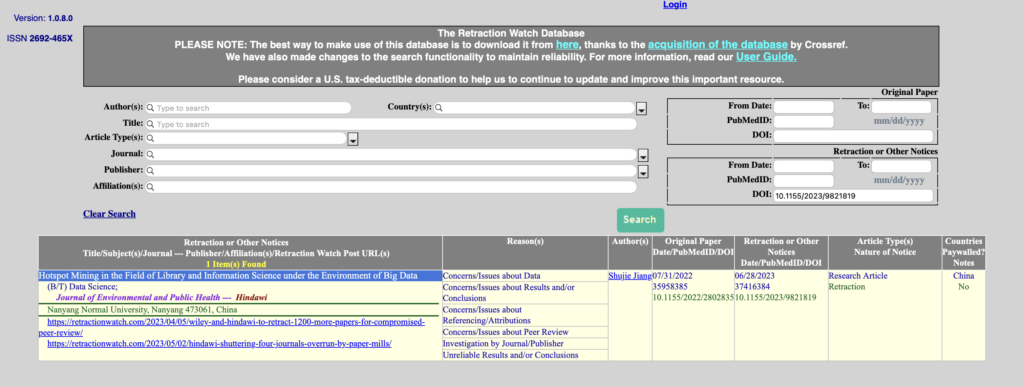
This can be particularly helpful in the following situations:
- Before citing relevant sources.
- For articles where you yourself have developed skepticism about the data or results presented.
- When you want to check a journal for credibility before submitting your own work and rule out a conspicuous number of retractions.
- To stay informed about current developments in the area of research integrity and the scientific publishing landscape.
In these cases, a simple search using the DOI (Digital Object Identifier: a permanent link that keeps a document findable even if its URL changes) of the article or the name of the respective publication is sufficient.
The Retraction Watch Integration for Zotero
For users of the open-source reference management software Zotero (see also the TUB’s short introductions) there is an alternative option for automated handling: the free Retraction Watch integration, which embeds directly into Zotero. Within the references stored in your own Zotero database, an automatic comparison with the Retraction Watch database takes place. Retracted articles are flagged and clearly marked with a note indicating the respective reason for the retraction:
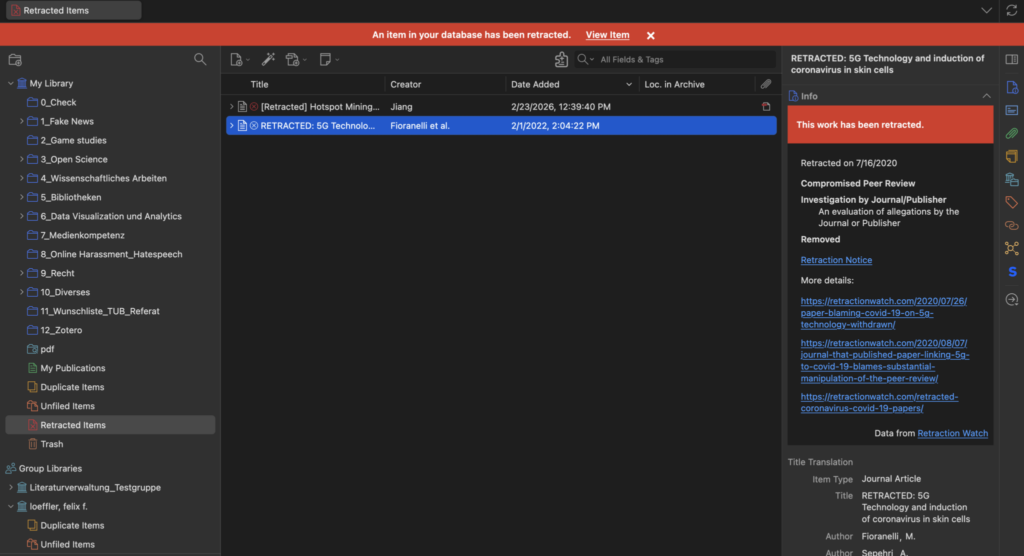
The Retraction Watch integration has been part of Zotero since 2019.
Practical tip: Get to know the Retraction Watch Integration and Zotero in the CWP workshop (25 February 2026)
Want to try out the Retraction Watch Integration together?
In the workshop series „Collect Write Publish“ we show how you can use reference management software such as Zotero for managing your literature and which criteria can support the individual selection of a reference management program.
Conclusion
Retractions are a sign that self-correction mechanisms in science are working. However, the number of retractions is steadily growing. At the same time, the overall volume of information continues to rise. Keeping track alongside actual research and publication processes is becoming increasingly challenging. Low-threshold tools such as Retraction Watch and the associated Zotero Integration can help avoid citing retracted articles in your own work unknowingly.
Further links
- Retraction Watch Database
- Retraction Watch Blog
- Further details on the Retraction Watch Integration in Zotero
- Committee on Publication Ethics (COPE)
- Collect, Write, Publish Workshops (Abstracts und Registration)
Correction (23 February 2026): The Retraction Watch integration in Zotero was originally referred to as a Zotero plugin. This has been corrected in the post. In addition, a link explaining how the matching process works has been added to the „Further Links“ section.