
In our „Database of the Month“ series, we regularly present research tools that support your academic work. This article focuses on OpenAlex.
Contents
- OpenAlex at a glance
- What is OpenAlex?
- Quick start: The first 3 steps
- What distinguishes OpenAlex
- Recent development: The Walden update
- Advanced usage options
- What should you watch out for?
- When is OpenAlex particularly useful?
- Practical tip: Get to know OpenAlex in the CWP workshop
- Conclusion
OpenAlex at a glance
- What: Free bibliographic database for academic literature
- Scope: 474+ million works (incl. datasets, software, research objects)
- Access: Free, no registration required
- Operator: OurResearch (non-profit, also known for Unpaywall)
- Start: https://openalex.org
What is OpenAlex?
OpenAlex is a freely accessible bibliographic database that provides metadata on academic publications, journals, authors, and institutions. The name is an allusion to the ancient Library of Alexandria, a symbol of knowledge and open access to information.
Why OpenAlex is interesting:
For many universities, the licensing costs of commercial databases such as Scopus and Web of Science are a recurring challenge. OpenAlex offers a free, transparent alternative here – entirely in the spirit of Open Science and Open Data. With now over 474 million academic publications (as of February 6, 2026), OpenAlex exceeds the data coverage of various established commercial services.
Special strengths:
- Open Access focus: clear identification of freely available versions
- Comprehensive coverage: not only journal articles, but also gray literature, preprints, datasets, and software
- Transparent data sources and methodology
- Multilingualism: not limited to the English-speaking world
Quick start for research: The first 3 steps
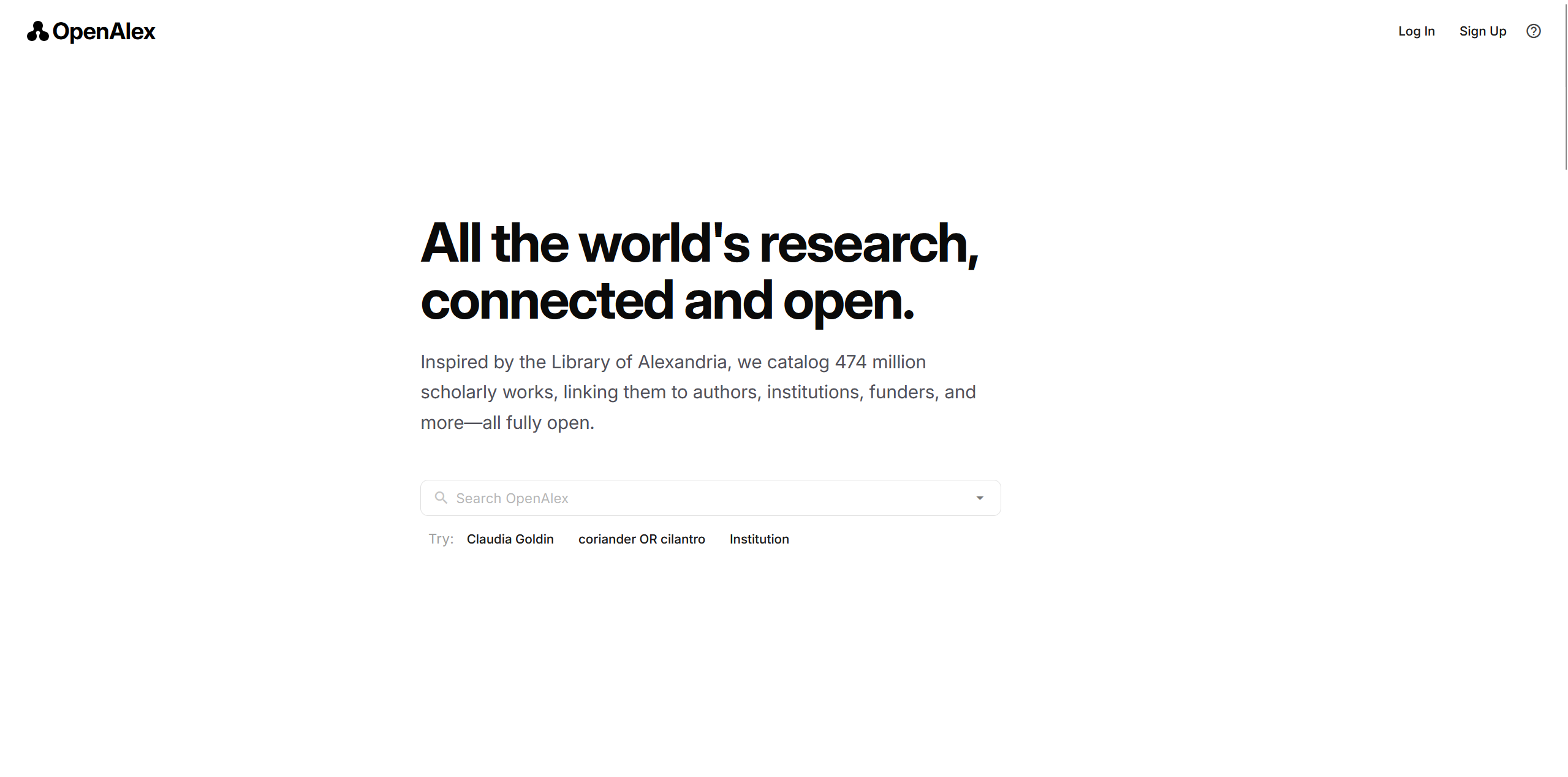
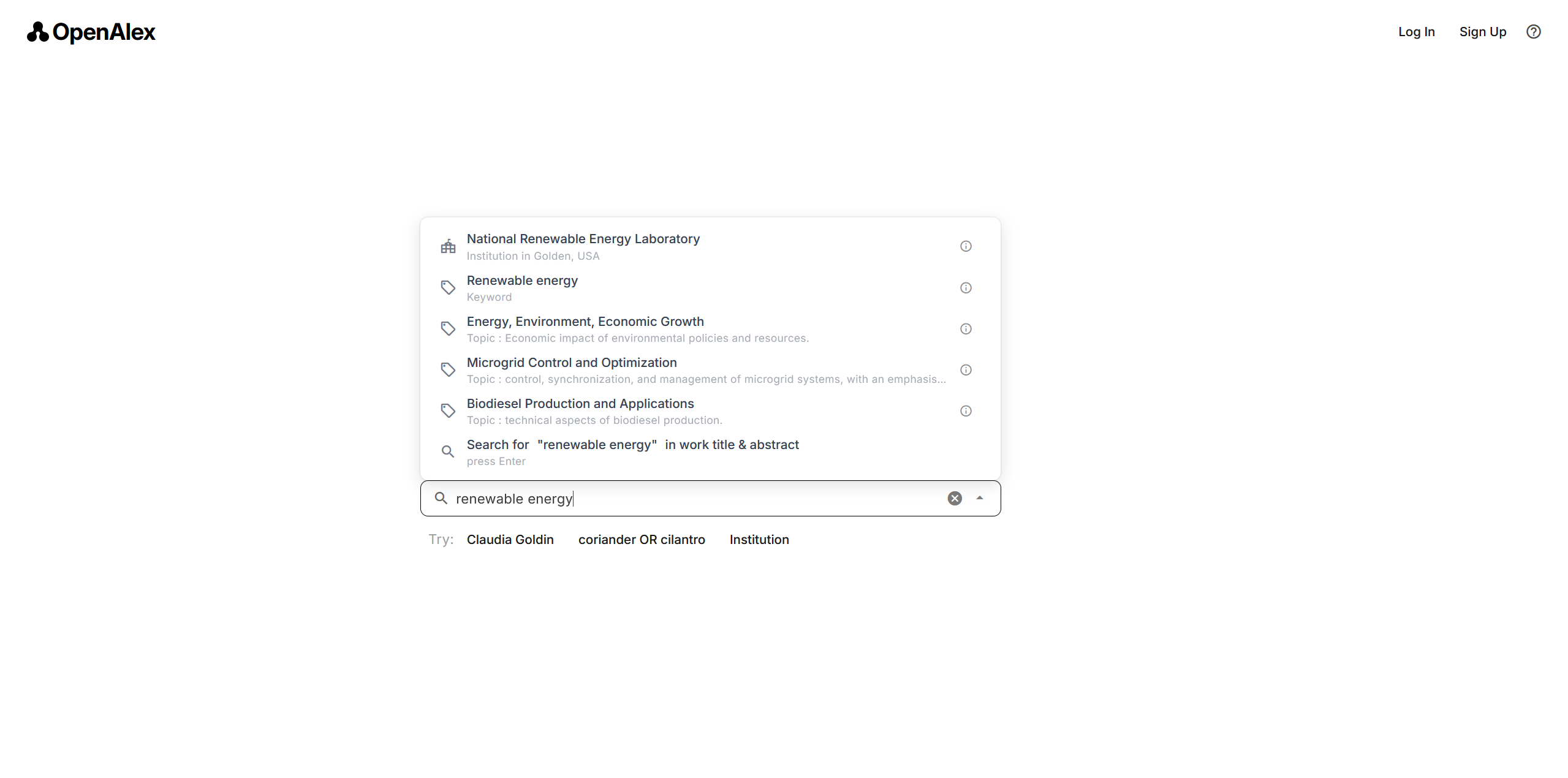
1. Start a thematic search
Enter a search term at https://openalex.org „renewable energy“. Suggestions appear as you type, along with the option „in work title & abstract“ for a comprehensive thematic search.
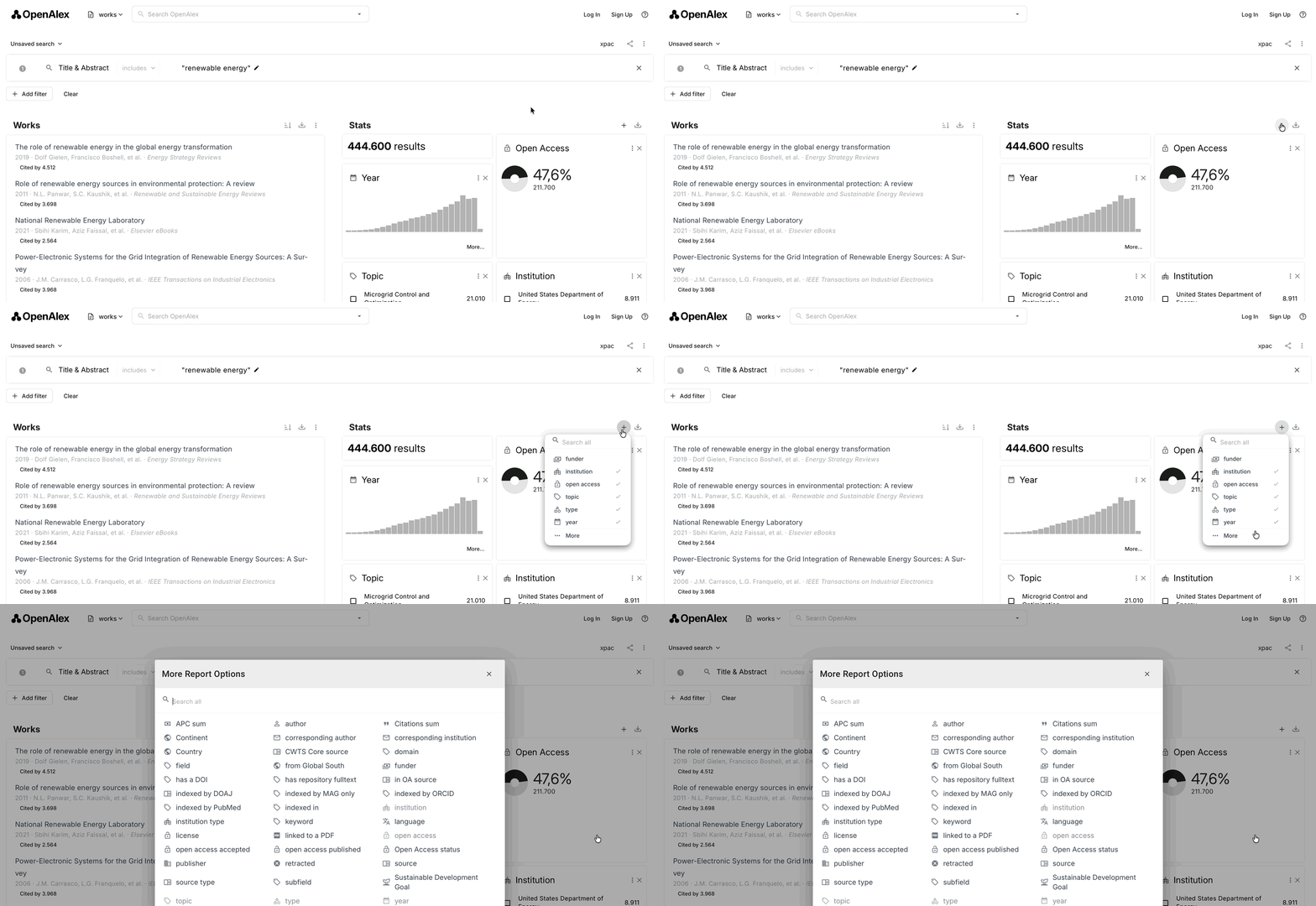
2. Use filters strategically
Results can be refined via the right column of the results view, including by:
- Publication type (articles, book chapters, preprints, datasets, software)
- Publication year or time period (e.g., „2020-2025“)
- Open Access status
- Language, continent, authors, institutions
- „indexed by DOAJ“ (for quality-assured Open Access journals)
In total, there are well over 30 filter options.
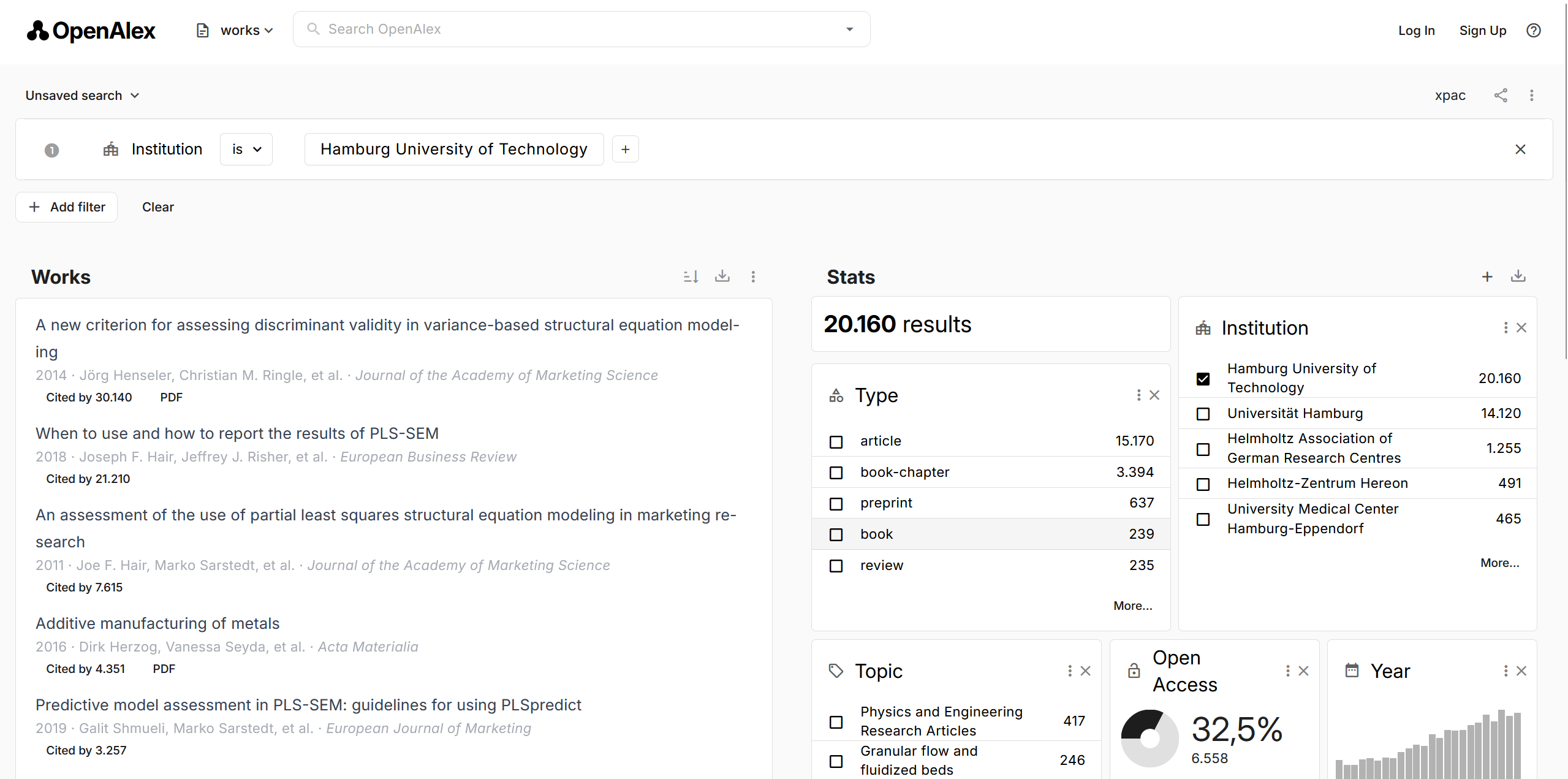
3. Institutional research
Institutions can also be searched directly via the search bar (e.g., „Hamburg University of Technology“). This allows you to view publication profiles, identify specific research areas, or analyze Open Access rates.
Practical tip: With a free OpenAlex account, search queries can be saved and alerts can be set up. This way, you’ll be automatically notified about new results.
What distinguishes OpenAlex
Data foundation
OpenAlex uses various trustworthy sources:
- Microsoft Academic Graph (MAG): Base dataset following the discontinuation of MAG in 2021
- Crossref: DOIs and metadata of academic publications
- ORCID: Unique researcher IDs
- DOAJ: Quality-assured Open Access journals
- PubMed/PubMed Central: Medical and biological literature
- DataCite: Datasets and research data
- Plus: Various academic repositories worldwide
A complete overview can be found in the official OpenAlex documentation.
Comparison with Established Databases
OpenAlex differs fundamentally from commercial services such as Scopus or Web of Science: it is completely free and openly accessible. The aforementioned scope of over 474 million works exceeds the database of established commercial services and includes not only journal articles but also books, preprints, datasets, software, and various publication types beyond traditional journal articles.
The methodology is transparently documented, and the API is freely usable (up to 100,000 requests/day). OpenAlex indexes publications in various languages, while commercial providers focus heavily on English-language literature. Quality filters such as DOAJ status are transparently accessible.
Recent development: The Walden update
In November 2025, OpenAlex rolled out a comprehensive rewrite („Walden“). Some important improvements:
- 190 million new works added (datasets, software, research objects from DataCite and thousands of repositories)
- Improved data quality: Better references, OA detection, language and license coverage
- Faster updates: Improvements are now rolled out in days instead of months
- More stable performance: Optimized infrastructure for faster search queries
The update demonstrates: OpenAlex is being continuously and actively developed.
Advanced usage options
For advanced users
API access:
The OpenAlex API allows up to 100,000 requests per day and is suitable for:
- Recurring searches
- Large-scale data analyses
- Network analyses
- Impact analyses
- Custom visualizations
Data snapshots:
Monthly updated complete copies of the entire database for comprehensive analyses. Details are included in the API-Dokumentation.
Application example
The Leiden Ranking Open Edition is based on OpenAlex data and offers a transparent, reproducible evaluation system for universities. TUB also uses OpenAlex for internal analyses and reports.
What should you watch out for?
Technical aspects
As a comparatively young service, minor delays when loading filters may occasionally occur. A free account helps to save search queries.
Data quality
Despite high quality, inconsistencies in metadata can occur (e.g., incorrect assignments of authors to institutions). Such errors can be reported via a correction request.
Handling problematic journals
Unlike Scopus or Web of Science, OpenAlex does not automatically filter out so-called predatory journals, but instead relies on transparency.
Practical tip: Use the „indexed by DOAJ“ filter (see also section „2. Use filters strategically“) to display only quality-assured open access journals that meet clear standards such as peer review and ethical guidelines.
Full-text access
As with all databases, access to full texts is limited, as many publishers offer content behind paywalls. However, OpenAlex clearly indicates which articles are available as Open Access.
When is OpenAlex particularly useful?
OpenAlex is especially suitable for:
- Comprehensive literature searches without budget constraints
- Interdisciplinary topics that go beyond traditional subject boundaries
- Open Access research and analyses of OA availability
- International perspectives, including non-English research
- Data-driven analyses (publication profiles, impact, networks)
- Research data search (datasets, software, code)
Practical tip: Get to know OpenAlex in the CWP workshop (February 11, 2026)
Want to try out OpenAlex practically and learn more about effective research strategies?
In the „Collect Write Publish“ workshop series, we show you how to use OpenAlex for research: from the first search to data analysis. The workshops combine theoretical knowledge with practical exercises and provide space for individual questions.
Conclusion: A worthwhile addition to everyday research
OpenAlex is more than just a tool for classic literature searches. The combination of openness, transparency, scope, and continuous development (see Walden update) sets OpenAlex apart from other databases.
Assessment:
You will be surprised at what a free, open offering like OpenAlex provides if you have previously worked „only“ with Scopus or Web of Science. Its strengths are evident both in terms of content diversity as well as filter functions and analysis capabilities.
Recommendation:
Include OpenAlex as a complementary source into your individual search strategy. Combined with established research tools, this creates a more comprehensive picture of the relevant scholarly literature.
Further links
- OpenAlex web interface: https://openalex.org
- Documentation: https://docs.openalex.org
- Blog: https://blog.openalex.org
- ORCID at TUB: https://www.tub.tuhh.de/publizieren/orcid/
- Predatory Journals Info: https://www.tub.tuhh.de/publizieren/openaccess/publikation/predatory/
- Collect Write Publish Workshops: https://www.tub.tuhh.de/blog/2026/01/01/collect-write-publish-2026-building-reliable-research-practices-in-the-digital-age/