
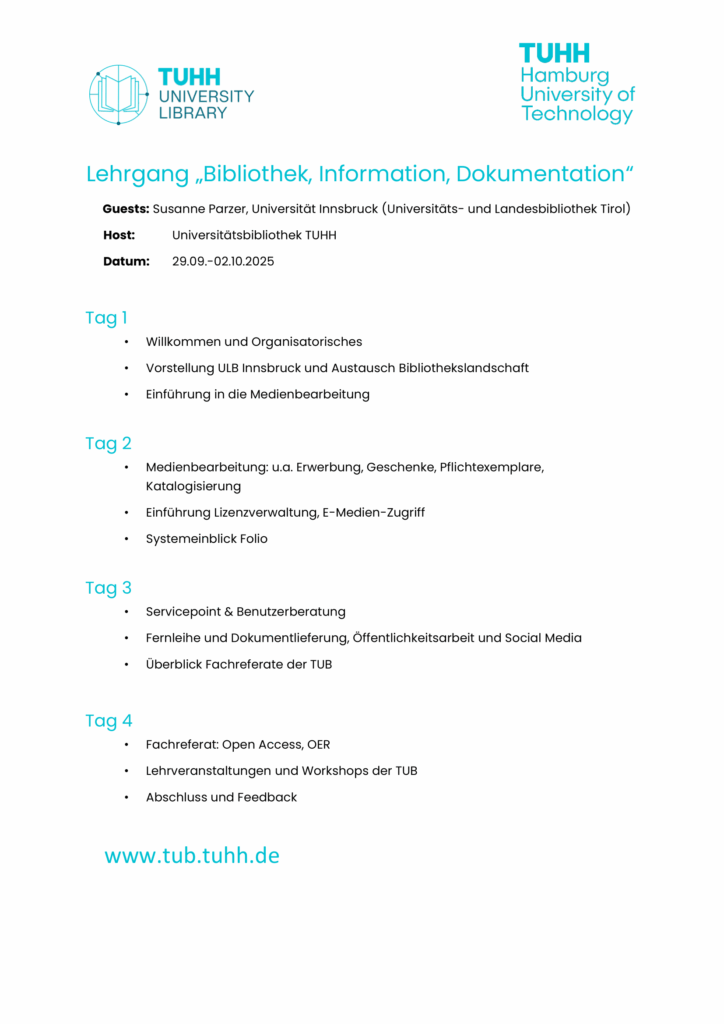
From September 29, 2025, to October 2, 2025, Susanne Parzer from the University of Innsbruck (ULB Tirol) was a guest at the TUHH University Library. The visit took place as part of her continuing education program in “Library, Information, and Documentation.” Afterwards, she wrote a short report on her experiences, which we are allowed to share openly on the library’s blog.
Visiting the TUHH University Library: Internship report from Innsbruck
My name is Susanne Parzer and I am currently completing the “Library, Information, and Documentation” course at ULB Tirol. This course combines theoretical content with practical insights into various departments, libraries, and information facilities. This also includes an external internship, which provides insights into other library systems and broadens one’s professional horizons.
Hamburg is not exactly around the corner. But port cities and regional differences in library structures interested me greatly. That’s why I did my internship at the University Library (TUB) of the Hamburg University of Technology (TUHH).
A week at the TUHH
From September 29 to October 2, 2025, I had the opportunity to get to know the various areas of the library and the campus in Harburg. The internship schedule was carefully organized. Among other things, I got to know the TUB’s user services, the subject liaison departments, media processing, and the library’s open access activities.
Exchange on equal terms
Right at the start of my internship, I had the opportunity to present my home library, the ULB Tirol, to interested colleagues during an introductory round. This exchange was particularly exciting in terms of identifying initial differences: we quickly got into conversation about the different architecture of our buildings, different service concepts, and organizational features. It became clear that an internship is not a one-way street. Rather, both sides benefited from the exchange: a large university and state library in Austria met a technically oriented university library in northern Germany. This offered exciting perspectives for comparison.
Media processing and cataloging
In the media processing department, I was given an overview of cataloging work at the TUHH and media acquisition. This also included insights into license management. Here, it became clear to me how different the processes can be depending on the library system and technical infrastructure. It was an interesting comparison to the processes I am familiar with from Innsbruck.
Subject Liaison Services: From Acquisition and Subject Indexing to Open Access and Open Education
In the subject liaison department, I was able to learn more about classic liaison activities such as processing acquisition suggestions and the subject indexing practices of TUB. For example, all media integrated into the library are tagged with basic classification notations as well as subject headings to improve searching in the catalog.
Besides classic activities, there are also liaison departments that deal with cross-disciplinary topics such as Open Access and Open Education. On the topic of Open Access, I gained insight into how TUB’s publication fund works. I also received an overview of which publishing agreements TU researchers can use, for example, for their publications. Topics like Open Access or openness in science also flow into other TUB offerings. These include, for example, a seminar on academic writing for bachelor’s students, open office hours, and other training opportunities. In the area of Open Education (learning material that can be openly shared and reused), the focus was on how libraries can actively contribute to promoting open educational resources and which tools can be used to create them.
Service Point: Focus on Users
At the service point, I was able to experience direct contact with users and got a sense of what questions and concerns arise in the daily life of a TUB. This direct exchange with students and researchers rounded out my insights into the various work areas of TUB. On the side, I was also able to witness how the final steps of the TU Library’s transition to an Open Library were being completed.
The Little Things That Stay in Your Memory
But an internship doesn’t consist only of tasks and processes. Often it’s also the small moments that stick with you most:
- “Moin” works at any time of day.
- “Libraries of Things” can work surprisingly well even in an academic context.
- Contrary to all stereotypes, it didn’t rain once during my stay – instead, there was bright sunshine the whole time.
- Cinnamon rolls are supposedly “out” in Hamburg, but Franzbrötchen are absolutely “in.”
- Students love puzzles – the Oswald von Wolkenstein puzzle (ULB special edition) thus proved to be the perfect gift, which will hopefully find its way into TUB’s collection.

Conclusion and recommendation
I was able to get a taste of many different areas of the TUB, from technical media processing and specialist departmental activities to forward-looking topics such as open access. I was given a warm welcome and quickly felt part of the team. My time in Hamburg was very enriching, both professionally and personally.
The comparison between a university and state library and a technically specialized university library was particularly valuable for me (professionally). I am taking many ideas back with me to Innsbruck, for example in the areas of subject indexing and open access strategies. For anyone considering it, an internship beyond the boundaries of your own library is highly worthwhile. I would like to express my sincere thanks to all my colleagues at TUB for this wonderful opportunity to broaden my horizons!

Further use as OER expressly permitted: Unless otherwise stated, this work and its contents are licensed under CC BY 4.0. Reference in accordance with TULLU-Regel please do as follows: “Visiting the TUHH University Library: Internship report from Innsbruck“ by Susanne Parzer, License: CC BY 4.0.