
Unsere Kollegin Patrizia Caló besuchte die Universitätsbibliothek der Technischen Universität Hamburg. Im Rahmen des Erasmus+-Staff-Mobility-Programms erhielt sie vom 20.04.2026 bis 24.04.2026 Einblicke in verschiedene Arbeitsbereiche. Im Nachgang hat sie einen kurzen Erfahrungsbericht geschrieben, den wir über das Blog der Bibliothek teilen dürfen. Weitere Informationen zur Erasmus+-Fort- und Weiterbildung im Ausland finden Sie auf den Webseiten der TUHH und des DAAD.
Motivation
My name is Patrizia Calò, and I work as a librarian at the Biblioteca Michele Brucoli in Bari, Italy. As part of my professional development, I wanted to gain first-hand experience of how an internationally oriented academic library operates outside Italy.
I chose the University Library of the Hamburg University of Technology (TUHH) for two main reasons. First, its strong focus on engineering and technology closely reflects the profile of my own institution. This makes it an ideal environment for professional exchange. Second, I found the library’s online presence to be clear and user-oriented, providing easy access to services, learning opportunities, and digital resources.
From 20 to 24 April 2026, I had the opportunity to visit the TUHH University Library through the Erasmus+ Staff Mobility Programme. During this week, I met colleagues from different departments, learned about their daily work, and gained insights into the services and workflows that support teaching, learning, and research at TUHH.
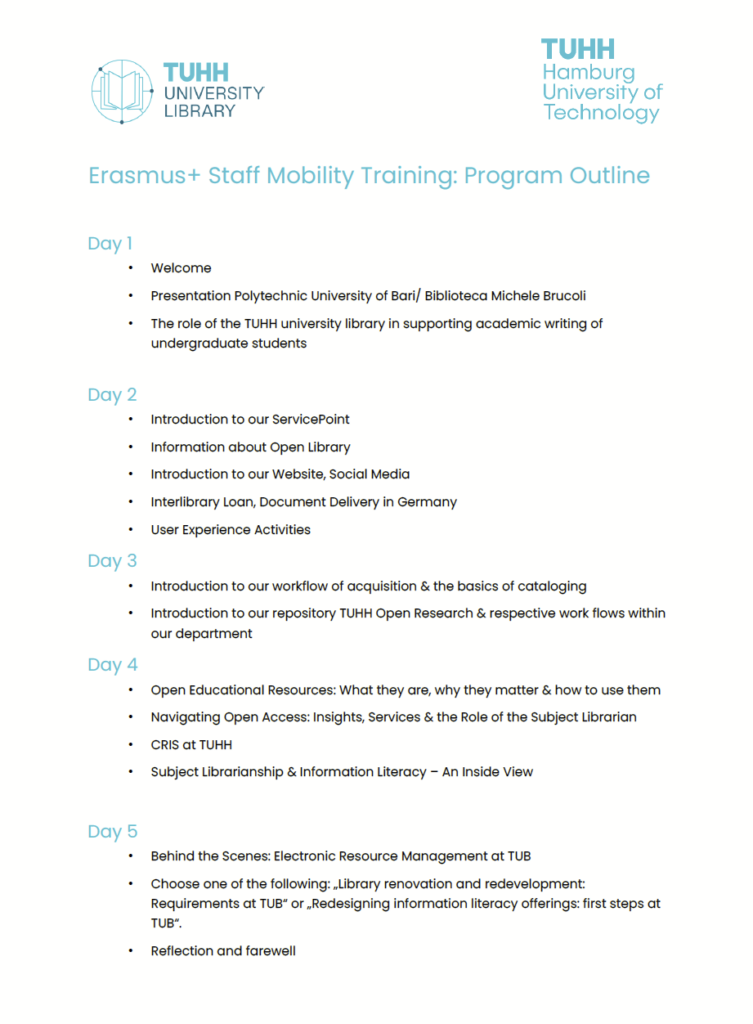
Learning Through Exchange
The following section highlights experiences of professional exchange and some key observations from the visit.
Exchange and Professional Dialogue
One of my highlights of the week was the presentation I gave at the beginning of my visit about my work at the Biblioteca Michele Brucoli in Bari. I was delighted by the strong interest from TUHH Library staff and the number of colleagues who attended the session. The discussion that followed created an open and welcoming atmosphere and turned the visit into a genuine exchange between colleagues rather than a one-sided observation programme.
This spirit of openness and exchange continued throughout the week. One of the most rewarding aspects of the visit was the opportunity to compare different approaches to similar challenges. While academic libraries across Europe often pursue the same goals, the ways in which services are organised and delivered can differ considerably.
Library Structures and Workflows
One of the most striking differences is staffing. The TUHH University Library operates with a considerably larger team than our library system in Bari. Our library currently consists of ten employees. As a result, this enables a higher degree of specialisation. In addition, it allows staff members to develop extensive expertise in specific areas of library work.
I was particularly interested in the workflows surrounding research communication, Open Access publishing, and repository management. The TUHH repository uses a double-validation process that I found especially effective in ensuring quality and consistency. At the same time, I observed a strong commitment to openness that extends beyond Open Access. This includes active engagement with Open Educational Resources (OER) and related support services.
Access and Shared Challenges
Another interesting difference concerns user access policies. While external users at the TUHH University Library pay a registration fee, library registration is generally free in Italy, including at my home institution.
At the same time, many challenges are shared across institutions and national borders. Like libraries throughout Europe, we continuously seek new ways to attract participants to training courses, strengthen information literacy skills, and communicate the value of library services. Conversations with colleagues quickly revealed how similar many of our concerns and objectives actually are. We also share practical challenges around physical collections. For instance, ensuring that multiple copies of the same title remain easy for users to locate.
Ideas for the Future
The Erasmus experience provided numerous ideas and examples of good practice that I hope to bring back to Bari.
I was particularly inspired by the TUHH University Library’s strategic approach to outreach and user engagement. A wide range of workshops, teaching activities, and consultation hours, together with an active presence on digital communication channels, helps make library services visible and easily accessible to the university community.
The visit also deepened my understanding of Open Education. Moreover, it demonstrated how libraries can actively support openness, collaboration, and knowledge sharing through educational services and resources.
Above all, this week reaffirmed the value of international exchange. Meeting colleagues from another country, discussing different approaches, and reflecting on shared challenges offered perspectives that extend far beyond everyday routines. Such experiences strengthen professional networks, inspire new ideas, and contribute to continuous professional development.
I would like to sincerely thank all colleagues at the TUHH University Library for their warm welcome, openness, and willingness to share their expertise. Their hospitality made this Erasmus visit both professionally enriching and personally memorable.

Weiternutzung als OER ausdrücklich erlaubt: Dieses Werk und dessen Inhalte sind – sofern nicht anders angegeben – lizenziert unter CC BY 4.0. Nennung gemäß TULLU-Regel bitte wie folgt: „New Ideas and Perspectives: An Erasmus Visit to the TUHH University Library„ von Patrizia Calò, Lizenz: CC BY 4.0.